
Durham Chinese School Visits UK Association for Chinese Language Education to Discuss Teaching Development

Share This
By Miss Yuting Guo
On the afternoon of February 11, 2023, Mr Haoyang Liu, Head Teacher of Durham Chinese School, accompanied by several teachers and volunteers, visited Mr Shanxiong Wu, President of the UK Association for Chinese Language Education (UKAPCE). The meeting focused on the future development of Chinese language education in the UK and key initiatives recently championed by UKAPCE: the development of a unified curriculum framework for Chinese language teaching and discussions around a standardized assessment for Chinese language learning in the UK.
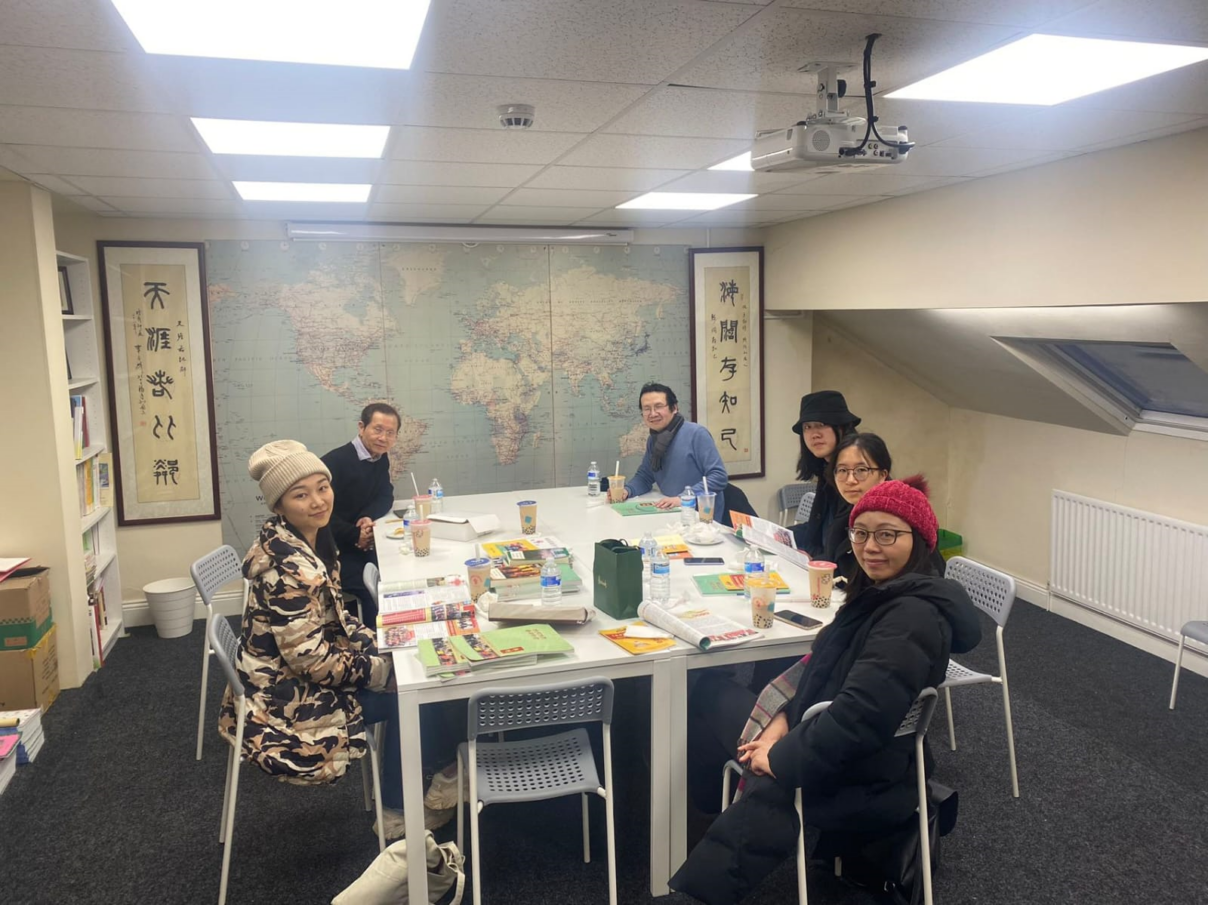
Mr Liu and President Wu began by sharing insights into the teaching facilities, faculty development, and textbook utilisation at Durham Chinese School and Newcastle Chinese School, respectively. Mr Liu emphasized the importance of adapting to local conditions and leveraging regional teacher resources to advance Chinese language education. He highlighted the significance of collaborating with Durham University to cultivate a pool of high-quality Chinese language teachers in the UK. Mr Liu stressed that faculty development is central to promoting Chinese education, noting that enhancing teachers’ professional competence requires long-term, sustained investment rather than short-term training. To this end, Durham Chinese School fosters teacher collaboration and research, encourages lead teachers to mentor teaching assistants, and promotes inter-departmental cooperation. Citing Ryan and Deci’s Self-determination theory regarding the fulfilment of needs for autonomy, relatedness, and competence, Mr Liu underscored the creation of an environment and teaching methodology that empowers teachers to engage in proactive learning, collaborative teamwork, and personal growth, thereby enhancing students’ in-school performance. Mr Liu expressed his hope that, over time, Chinese language teachers would develop greater autonomy in their teaching methods, self-awareness in classroom management, and form professional learning communities for collaborative research, ultimately driving innovation in Chinese language instruction and making children’s Chinese learning more scientific, effective, and engaging.
President Wu then presented ideas for establishing a UK-wide Chinese language curriculum framework and a standardized assessment. He highlighted the importance of teaching continuity, arguing that merely learning characters from textbooks is insufficient; a more comprehensive and continuous system for Chinese language learning and evaluation is essential.

Specifically: Firstly, regarding the development of a unified Chinese language curriculum framework, President Wu referenced the spirit of previous UKAPCE “UK Chinese School Chinese Language Teaching Symposia.” He emphasized the need to gather teaching experiences and various teaching materials from Chinese school teachers across the UK. Through bottom-up discussions, actively involving teachers and leveraging their professional insights, the aim is to collectively establish a Chinese knowledge system suitable for students of different age groups. He stressed that this spontaneous deliberation and exploration, combined with teachers’ mutual sharing and integration of knowledge, would make the teaching process more dynamic and flexible, fostering both students’ academic growth and the professional development of the teaching collective.
Secondly, concerning the implementation of a standardised assessment, President Wu posited that once the curriculum framework is in place, effective evaluation tools are needed to measure students’ Chinese language proficiency. A standardized assessment could serve as an objective evaluation method, enabling teachers to adjust teaching directions and strategies based on results, thereby gaining a more precise understanding of student levels and reducing subjective judgment. He stated that UKAPCE would organize discussions among all UK Chinese schools to steadily advance the vision for a unified Chinese language curriculum framework and assessment until its realization.
During this visit, both parties reached a consensus: the accumulation of Chinese language teaching expertise requires time and dedication, necessitating continuous teaching adjustments by educators through curriculum implementation and student assessment. It further calls for collaborative efforts from all UK Chinese schools and teachers to collectively promote the continuous growth and progress of students, teachers, and Chinese language schools.
Where the heart aspires, the path will follow.
杜伦中文学校新春走访英国中文教育促进会,共话教学发展
作者:郭玉婷
2023年2月11日下午,杜伦中文学校校长刘浩洋携学校部分教师及志愿者,拜访英国中文教育促进会会长伍善雄先生,就英国中文教育的未来发展及近年促进会关注的重点议题——英国中文教学课程框架与统一考试的研讨——进行了深入交流。
首先,刘校长和伍会长分别代表杜伦中文学校和纽卡斯尔中文学校,就各自学校的教学设施、师资培养和教材使用情况进行了分享。刘校长提出,中文教育的发展需因地制宜,有效利用本地资源至关重要。他特别强调与杜伦大学合作,以储备和培养高素质的中文教师。刘校长认为,师资是推动中文教育发展的核心。他指出,教师专业素养的提升应是长期且持续的投入,而非短期培训可速成。为此,杜伦中文学校致力于促进教师间的合作与教研,班主任对助教的培养指导,以及各部门间的协同配合。他援引自决理论(Self-determination theory)中关于自主、关联和胜任的需求,强调营造一种环境,使教师能够主动学习、协作互助、促进自我成长,从而提升学生的学习表现。刘校长期望,通过持续的努力,中文教师能逐步形成教学方法上的自主决策能力,课堂管理的自我意识,并成为专业学习共同体的一员,从而共同推动中文教学创新,使学生的中文学习更加科学、有效且富有乐趣。
随后,伍会长阐述了构建全英中文课程框架和统一考试的设想。他强调教学连贯性的重要性。他认为,仅仅学习书本上的汉字是不够的,构建更为全面和连续的中文学习与评估体系至关重要。
具体而言: 首先,关于统一中文教学课程框架的制定。伍会长指出,借鉴英国中文教育促进会以往“英国华校中文教学研讨会”的精神,应汇集来自全英各中文学校教师的教学经验及各类教材,并通过自下而上的方式进行研讨,充分发挥教师的积极性和专业洞见,共同制定出适合不同年龄阶段学生需求的中文知识体系。他强调,这种自发的思考和探索,以及教师间“传道、授业、解惑”的分享与整合,将使教学过程更具流动性和灵活性,促进学生学业成长和教师集体专业发展。
再者,关于统一考试的推行。伍会长认为,课程框架制定后,需要有效的评估工具来衡量学生的中文水平。统一考试可作为一种客观测评方式,帮助教师根据结果调整教学方向和策略,从而更精准地了解学生水平,减少主观判断。他表示将组织全英中文学校进行研讨,稳步推进统一中文教学课程框架和考试的设想,直至实现。
此次交流中,双方形成共识:中文教学的积累需要时间和沉淀,需要教师们不断通过课程的实施与学生测评来进行教学调整,更需要全英中文学校及教师们通力合作,共同促进学生、教师和中文学校的持续成长与进步。
心之所向,素履以往。